Triple Debt Model: Technical, Cognitive, and Intent Debt in the AI Era
Definition
The Triple Debt Model is a unified diagnostic framework for reasoning about software system health. Formulated by Margaret-Anne Storey, it expands the traditional concept of technical debt to account for the unique failure modes introduced by generative AI and agentic software development.
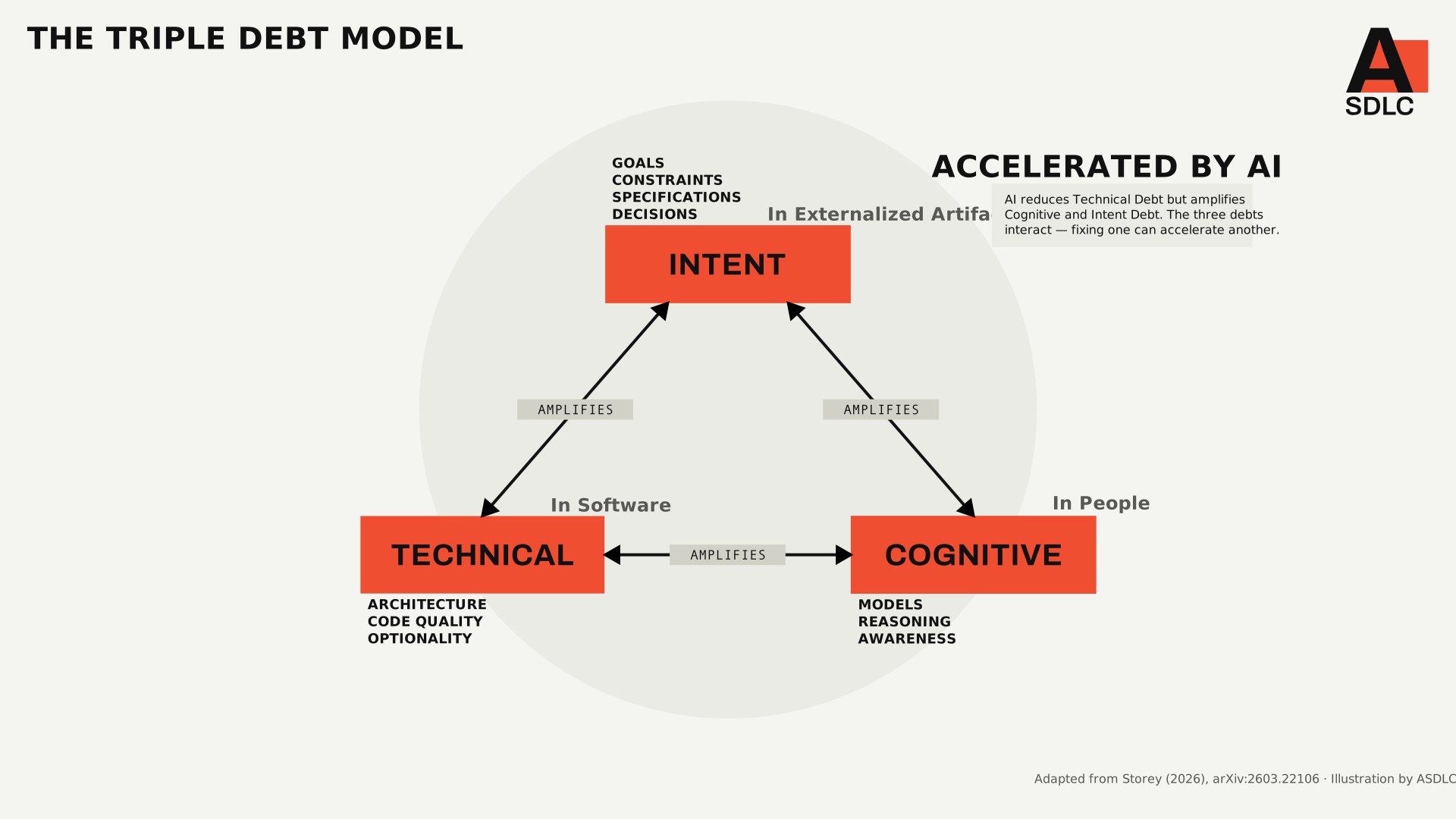
The model posits that system health degrades across three interconnected vectors: Technical Debt (in code), Cognitive Debt (in people), and Intent Debt (in externalized artifacts). Storey argues that generative AI may lower technical debt while cognitive and intent debt build up faster.
The Three-Layer System Model
A software system is not just source code. It exists across three distinct layers, each capable of accumulating its own form of debt:
- Software (Code): The running application and executable logic.
- People (Understanding): The shared mental models, domain knowledge, and operational understanding held by the human team.
- Artifacts (Intent): The externalized rationale, decisions, constraints, and specifications that exist outside of both the code and the developers’ minds.
System health requires continuous alignment across all three layers.
Technical Debt: The Visible Layer
- Domain: Lives in Code.
- Definition: Suboptimal implementation choices (e.g., duplicated logic, missing tests, poor performance) that compromise future maintainability.
- AI Impact: Generative AI shows tremendous promise for reducing technical debt through automated refactoring, code generation from specs, and comprehensive test suite creation. It is the best-understood and most measurable debt type.
Cognitive Debt: The Invisible Layer
- Domain: Lives in People.
- Definition: The erosion of a team’s shared mental models and operational understanding of the system they maintain.
- Cognitive Surrender vs. Cognitive Offloading:
- Cognitive Offloading is strategic and healthy: delegating rote tasks (syntax generation, boilerplate) to an agent to free up mental capacity for higher-level architectural reasoning.
- Cognitive Surrender (Shaw & Nave, 2026) is pathological: adopting AI outputs with minimal scrutiny and bypassing both intuition and deliberate reasoning entirely. The human accepts the code without understanding its implications.
- Diagnostic Indicators: Severe resistance to making architectural changes, unexpected production results, extremely low bus factor, developer burnout, and unusually slow onboarding of new team members who cannot comprehend the AI-generated maze.
Intent Debt: The Forgotten Layer
- Domain: Lives in Artifacts.
- Definition: Missing or eroded explicit rationale, goals, and constraints for guiding a system’s evolution. It accumulates when these are unclear, poorly articulated, or not captured in artifacts that humans and AI agents can consult.
- Characteristics: Practitioner terms like “context debt” are symptoms of systemic Intent Debt. Intent is inherently ephemeral; it is best captured at the exact moment of decision (e.g., during the Learning Loop).
- The Machine Context Gap: Unlike technical debt, lost intent cannot always be reverse-engineered. Crucially, in agentic workflows, intent must be machine-readable (via MCP) to prevent agents from operating on hallucinations or outdated assumptions. Once intent is gone, any future modifications—by human or agent—are blind guesses.
Interaction Dynamics
The three debt types do not exist in isolation. They form a bidirectional web where debt in one layer accelerates decay in the others:
How AI Shifts the Balance
In pre-AI development, the sheer friction of writing code manually forced a feedback loop. Translating an idea into syntax required the developer to deeply understand the system (reducing Cognitive Debt) and continuously hold the constraints in their mind (managing Intent Debt).
Generative AI can weaken this feedback loop by lowering the effort needed to produce code. Storey argues that Technical Debt may decrease while Cognitive and Intent Debt accumulate faster, creating a risk of Legacy Code in record time.
ASDLC Usage
The Agentic Software Development Life Cycle (ASDLC) is fundamentally designed to mitigate the Triple Debt Model through formal operational constraints.
Our mapping to the mitigation hierarchy:
- Mitigating Intent Debt: ASDLC mandates “intent-first” workflows. Intent Debt is primarily combatted through the Agent Constitution (project-level intent), The Spec (feature-level intent), ADRs (decision rationale), and BDD Scenarios (executable intent).
- Mitigating Cognitive Debt: Addressed through Human-in-the-Loop reviews, the Learning Loop, and Adversarial Requirement Reviews. Crucially, the process of authoring and refining a specification builds genuine cognitive alignment across the team.
- Mitigating Technical Debt: Controlled via Context Gates, deterministic automated verification, and AI-assisted continuous refactoring.
[!WARNING] Resist the Automation of Understanding
Generating artifacts, documentation, and specifications entirely via AI without deep human engagement is a catastrophic anti-pattern. It “substitutes the appearance of understanding for the real thing.” Artifacts must represent true human intent, not just another layer of generative hallucination.
References
- (2026).
From Technical Debt to Cognitive and Intent Debt: Rethinking Software Health in the Age of AI
.
Accessed October 8, 2026.
Proposes the Triple Debt Model. Version 4 clarifies the intent-debt definition.
- (2026).
Thinking-Fast, Slow, and Artificial: How AI is Reshaping Human Reasoning and the Rise of Cognitive Surrender
.
Accessed March 25, 2026.
Defines Cognitive Surrender — adopting AI outputs with minimal scrutiny, bypassing both intuition and deliberate reasoning. Distinct from Cognitive Offloading.
- (2026).
Cognitive Debt
.
Accessed March 25, 2026.
Early practitioner discussion of cognitive debt in AI-assisted development, cited by Storey.
- (2026).
You Need AI That Reduces Your Maintenance Costs
.
Accessed May 26, 2026.
Agile pioneer's mathematical model showing how AI-assisted code output chokes long-term productivity unless maintenance costs decrease proportionally.