Getting Started with Agentic SDLC: Setup Guide
What Is This?
ASDLC (Agentic Software Development Life Cycle) is a framework for building software with AI agents—not as toys or assistants, but as industrial infrastructure.
Vibe coding is powerful for exploration and prototyping. Production requires more. When code must be maintained, extended, and trusted, you need schemas, contracts, gates, and governance. ASDLC provides the methodology for that transition.
“Agentic architecture is the conveyor belt for knowledge work.”
— Ville Takanen
If that sounds like overkill for your weekend project, it probably is. ASDLC is for teams building production software who want deterministic, repeatable outcomes from non-deterministic AI systems.
The Core Idea
Agents don’t replace developers. They industrialize execution.
Think automotive manufacturing: robotic arms automate welding, but they don’t replace the need for manufacturing expertise. Someone still designs the car, optimizes the assembly line, and ensures quality control.
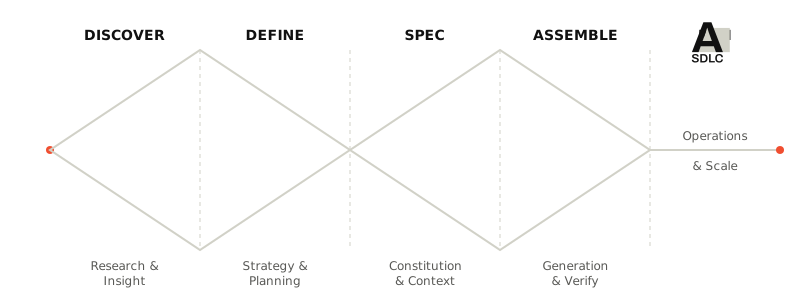
How It Works?
ASDLC defines three layers:
| Layer | Function | Human Role |
|---|---|---|
| Context | The supply chain—requirements, schemas, specs delivered just-in-time | Editor |
| Agents | The logistics layer—moving information, generating code, running tests | Operator |
| Gates | Quality control—deterministic checks + human oversight | Governor |
The human contribution shifts from writing code to designing systems, defining contracts, and verifying output.
The Five-Minute Version
If you remember nothing else:
- Write specs before code. The Spec is the permanent source of truth. Agents read it; code fulfills it. No spec, no build.
- Treat context as code. Your AGENTS.md file is version-controlled, peer-reviewed, and optimized for agent consumption.
- Use gates, not hope. Context Gates enforce quality at three levels: deterministic (compilers, tests), probabilistic (AI review), and human (strategic fit).
- Separate state from delta. The Spec defines how it works (state). The PBI defines what changes (delta). Don’t conflate them.
- Commit constantly. Micro-Commits are save points. When an agent generates garbage in file 4 of 10, you roll back without losing everything.
Learning Paths
Path A: “I want to understand the philosophy”
Start with the concepts that define the methodology:
- Agentic SDLC — The manifesto. Why industrialization, why L3 autonomy, why determinism over vibes.
- Levels of Autonomy — The SAE-inspired scale. We standardize at L3 (Conditional)—agents execute, humans instruct.
- Context Engineering — Why context is your most valuable asset, not the model.
- Vibe Coding — Where unstructured generation works, where it doesn’t, and how ASDLC bridges the gap.
Path B: “I want to ship something today”
Start with the practices you can implement immediately:
- AGENTS.md Specification — Create the file that steers every agent in your repo. 30 minutes.
- Living Specs — Write your first spec. Template included. 1 hour.
- PBI Authoring — Structure work items agents can actually execute. 30 minutes.
- Micro-Commits — Change your git habits. Immediate.
- Adversarial Code Review — Validate agent output against your spec using a Critic Agent. 15 minutes.
Path C: “I want to design the whole system”
Understand how the pieces connect:
- Spec-Driven Development — The overarching methodology.
- The Spec + The PBI — State vs. delta, permanent vs. transient.
- Context Gates — Input filtering, output validation, the three-tier system.
- Adversarial Code Review — Using a Critic Agent to validate Builder output.
- The ADR — Architecture Decision Records as immutable context for agents.
Quick Reference
Key Artifacts
| Artifact | Location | Purpose |
|---|---|---|
AGENTS.md | Repo root | Agent constitution, tech stack, commands |
specs/{feature}/spec.md | Per feature | Permanent source of truth |
tasks/PBI-XXX.md | Backlog | Transient execution unit |
ARCHITECTURE.md | Repo root | Global system constraints |
docs/adrs/ | Repo root | Architecture Decision Records |
The Gate Hierarchy
ASDLC recommends a 3-tier “guardrail” system with deterministic quality gates, probabilistic review gates, and human-in-the-loop acceptance gates.
flowchart LR
  subgraph Deterministic
    QG["Quality Gates"]
  end
  subgraph Probabilistic
    RG["Review Gates"]
  end
  subgraph Human-in-the-Loop
    AG["Acceptance Gates"]
  end
  subgraph 0
    M["Merge"]
  end


    QG -->|"Pass"| RG
    RG -->|"Pass"| AG
    AG -->|"Approve"| M

See the article Context Gates for additional details on the gate hierarchy.
What ASDLC Is Not
- Not a prompt library. We don’t collect “awesome prompts.” We define systems.
- Not a tool recommendation. Cursor, Claude Code, Windsurf—use what works. The methodology is tool-agnostic.
- Not about replacing developers. It’s about changing what developers do: less typing, more designing.
- Not magic. Agents are probabilistic. They drift toward mediocrity. ASDLC provides the constraints that keep them useful.
Next Steps
- Read the Agentic SDLC overview — Understand the thesis.
- Add
AGENTS.mdto your repo — Use the template. - Write one spec — Pick a feature, follow the Living Specs guide.
- Draft an ADR — Document a key decision using the ADR pattern.
- Try the loop — Spec → PBI → Implementation → Gate → Merge.
Questions? The methodology is documented. The patterns are linked. Start building.
Accessing the Knowledge Base
Stay grounded in official ASDLC patterns and practices through two primary agent-ready interfaces:
1. Model Context Protocol (MCP)
The ASDLC Knowledge Base is a live MCP server. Connect your agent to:
https://asdlc.io/mcp
Tools available: search_knowledge_base, get_article, list_articles.
The modern transport uses stateless HTTP and requires MCP 2026-07-28; legacy
clients must upgrade. The TypeScript SDK client 2.0.0 has passed preview
verification with that revision pinned. Claude Code and other agent hosts remain
unverified against the modern endpoint.
2. Downloadable Static Skill
For offline, local-first, or air-gapped workflows, use the Downloadable Static Skill. This is a self-contained bundle of the Knowledge Base with relative links and agent-optimized manifest.
- Download: asdlc-skill.zip
- Setup: Extract into
.asdlc/or.cursorrules/in your repo. - Usage: Point your agent to the
SKILL.mdmanifest as a context anchor.