Agentic Double Diamond
Definition
The Agentic Double Diamond is a computational framework that transforms the traditional design thinking model (Discover, Define, Develop, Deliver) into an executable pipeline where every phase produces machine-readable context rather than static artifacts.
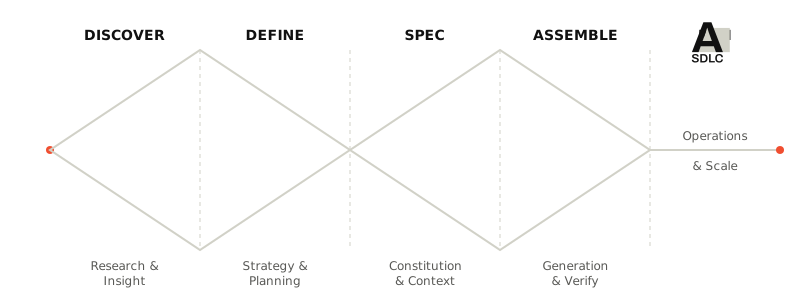
In this model, the Spec becomes the primary source code, and “Coding” becomes an automated assembly step. The human role shifts from Implementation to Context Engineering and Verification.
The Problem: Lossy Handoffs
Traditional software development suffers from signal degradation at every handoff:
- The “Gap of Silence”: Insights from the Discover phase are summarized into PowerPoints or tickets, stripping away the raw evidence needed for edge-case validation.
- Static Deliverables: The Define phase produces Figma files or flat requirements. To an AI, these are unstructured blobs. Use of “Vibe Coding” creates functionality that feels right but fails under rigorous scrutiny.
- Verification Lag: We typically only verify if we built the thing right (Testing) after weeks of coding. We rarely verify if we are building the right thing (Strategy) until it’s too late.
The result is a “Build Trap” where we efficiently ship features that solve the wrong problems.
The Solution: A Computational Pipeline
The Agentic Double Diamond reimagines the two diamonds not as workshop phases, but as Context Furnaces. Each furnace ingests raw, unstructured input and refines it into a stricter, more deterministic state.
- Diamond 1 (Problem Space): Ingests Chaos $\rightarrow$ Refines to Insight.
- Diamond 2 (Solution Space): Ingests Insight $\rightarrow$ Refines to Implementation.
Crucially, we introduce Adversarial Gates at the convergence points of each diamond to stop “Solution Pollution”—the tendency to rush into building without a valid problem definition.
Anatomy
The pattern consists of four computational phases and one operational phase (Run).
Phase 1: DISCOVER (The Sensor Network)
From Chaos to Signal.
Instead of manual research sprints, we use agents to ingest broad signals (user feedback, logs, market data) and cluster them into patterns.
Context Output: Problem Graph (A structured map of user needs and pain points).
- Practices:
- Experience Modeling: Defining the domain language and user journey.
- Context Engineering: Structuring the raw input for analysis.
Phase 2: DEFINE (The Strategy Engine)
From Signal to Insight.
We crystallize the signals into a coherent strategy. This is where Product Thinking applies constraint satisfaction to select the right problem to solve.
Human Role: Thought Leader (Deciding what matters). Agent Role: Thought Partner (Challenging assumptions).
Context Output: Strategy Document & Validated Problem Statement.
- Gate 1 (The Checkpoint): Adversarial Requirement Review.
- Before writing a single line of a Spec, an Adversarial Agent challenges the strategy constraints. If it fails, we loop back to Discover.
Phase 3: SPEC (The New Coding)
From Insight to Blueprint.
This is the most significant shift. In the Agentic SDLC, Spec Writing IS Coding. The Spec is the permanent, living source of truth. It defines the “What” (Behavior) and the “How” (Architecture) in a format rigorous enough for agents to execute.
Context Output: The Spec (Context, Blueprint, Contract).
- Practices:
- Spec-Driven Development: The methodology of writing specs first.
- Living Specs: Treating documentation as code.
Phase 4: ASSEMBLE (The Agentic Manufactory)
From Blueprint to Assembly.
Agents ingest the Spec and “assemble” the implementation. This phase is highly automated. The agents generate code, tests, and documentation that adhere strictly to the Spec.
Human Role: Verifier (Reviewing the assembly against the Spec). Agent Role: Builder (Implementation).
Context Output: Source Code, Tests, Micro-Commits.
- Gate 2 (The Checkpoint): Adversarial Code Review.
- An independent Critic Agent verifies the assembled code against the Spec’s Contracts. It catches edge cases and architectural violations that unit tests might miss.
- See also: Micro-Commits and Feature Assembly.
Phase 5: RUN (The Feedback Loop)
From Assembly to Signal.
The software operates in production, generating new signals (usage data, errors, feedback) that feed back into Phase 1, closing the loop.
- Practices:
- Feedback Loop Compression: Minimizing the time between “Run” and “Discover”.
- Production Readiness Gap: Managing the transition from prototype to production.
Relationship to Other Patterns
- Product Thinking: The mindset that drives the Discover/Define phases.
- The Spec: The central artifact connecting Define to Assemble.
- Agent Constitution: The set of laws that govern agent behavior throughout the pipeline.
- Context Gates: The architectural pattern implemented by the Adversarial Reviews.
Anti-Patterns
The Vibe Coding Shortcut
Problem: Skipping the Define and Spec phases to jump straight to Assemble (Vibe Coding). Consequence: Fast “sugar-high” shipping of features that crumble under production complexity because they lack structural integrity.
The Static Spec
Problem: Treating Phase 3 as a “PDF generation” step. Consequence: The Spec drifts from reality immediately. In this pattern, the Spec must be a Living Spec in the repo, or the automated assembly fails.
Industry Implementations
The Agentic Double Diamond is a theoretical model that maps closely to emerging industry practices. A concrete example is the Effective Delivery AI-driven framework, which observed a 30-40% development speed increase using a 4-phase “copilot-collections” workflow that tightly aligns with our phases:
- Research $\rightarrow$ Discover: Agents build context around a task and source related information.
- Plan $\rightarrow$ Define / Spec: Agents create a structured implementation plan with clear acceptance criteria.
- Implement $\rightarrow$ Assemble: Specialized engineers (Frontend/Backend) execute against the agreed plan.
- Review $\rightarrow$ Assemble (Verification Gate): Critic agents perform structured code reviews, verifying against Figma designs or the implementation plan.
This workflow demonstrates that creating specialized context furnaces (their Research/Plan phases) before implementation leads to measurable, significant gains over standard “vibe coding” with a single LLM prompt.
References
- .
The Double Diamond
.
Accessed February 12, 2026.
Origin of the Diverge-Converge model.
- .
Software Craftsmanship in the AI Era
.
Accessed February 12, 2026.
Source of the 'Spec is Code' philosophy.
- .
Before I Ask AI to Build, I Ask It to Challenge
.
Accessed February 12, 2026.
Source of the Adversarial Requirement Review pattern.
- .
AI-Driven Development Framework
.
Accessed February 25, 2026.
A practical implementation of the Agentic Double Diamond using GitHub Copilot showing a 30-40% speed increase.